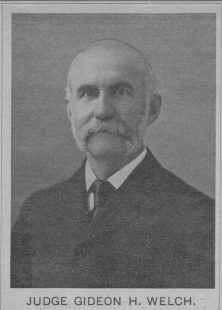
 Gideon Hugh Welch (September 22, 1844 - September 29, 1927) graduated from Yale College in 1868 (and later Yale Law School in 1870), subsequently serving as a lawyer, judge,
and Connecticut state senator.
Gideon Hugh Welch (September 22, 1844 - September 29, 1927) graduated from Yale College in 1868 (and later Yale Law School in 1870), subsequently serving as a lawyer, judge,
and Connecticut state senator.Queer Places:
Yale University (Ivy League), 38 Hillhouse Ave, New Haven, CT 06520
Hillside Cemetery, 76 Walnut St, Torrington, CT 06790, United States
Gideon Hugh Welch (September 22, 1844 - September 29, 1927) graduated from Yale College in 1868 (and later Yale Law School in 1870), subsequently serving as a lawyer, judge,
and Connecticut state senator.
Born in East Haddam, Connecticut, on September 22, 1844, Gideon Higgins Welch came from deep New England roots. He was the son of merchant James Munroe Welch and Eliza Matilda (Higgins) Welch, through whom he traced his lineage back to his great-grandfather Hawes Higgins, a veteran of the Revolutionary War. After completing his preparatory studies at the Wesleyan Academy in Wilbraham, Massachusetts, Welch entered Yale College with the Class of 1868.
During his undergraduate years, Welch distinguished himself academically—earning a First Colloquy appointment in his Junior year and a Second Dispute appointment as a Senior—while actively participating in the Delta Kappa fraternity. His letters to his grandfather during his time at Yale offer a vivid window into student life in the 1860s. He detailed the grueling academic pressure of the period, writing of entire terms spent in relentless review sessions to avoid public failure during recitations.
Beyond academics, Welch’s correspondence captures the deep homosocial dynamics and student intimacy of the era, a subject explored by historian Matthew Busick in his study "Becoming a Yale Man: Intimacy among Yale Students in the Nineteenth Century" (2007). Welch frequently wrote of balancing competitive academic rivalries with a deep longing for companionship, noting at one point, "I had begun to feel lonesome and as if I wanted someone to talk to." He spoke fondly of his roommate Clarence, describing him as "a very good man to room with… very attentive to his studies," reflecting how success and emotional support were inextricably linked in 19th-century campus dormitories.
After earning his Bachelor of Arts in 1868, Welch transitioned directly into Yale Law School. He balanced his legal studies by clerking in the office of attorney George H. Watrous and serving as the City Clerk of New Haven. Earning his LL.B. in 1870, he was admitted to the Connecticut Bar the following autumn and moved to Torrington, Connecticut, where he would build a distinguished legal and public career spanning over five decades.
In Torrington, Welch quickly established himself as a central figure in local government, judicial affairs, and civic life. He served in a wide range of municipal roles, including Town Clerk, Registrar of Vital Statistics, and Justice of the Peace. As a key author of Torrington’s municipal charter, he became the borough's first clerk and later served as a judge for both the Borough Court and the Probate Court. His legal career reached the state level in 1881 when he was elected to the Connecticut House of Representatives, where he chaired the Committee on the State Prison. He later served in the State Senate from 1897 to 1899 as Chairman of the Committee on Incorporations.
In 1897, Welch was appointed Judge of the Court of Common Pleas for Litchfield County, a position he held until reaching the mandatory age limitation in 1914. Upon his retirement from the bench, the General Assembly honored his service by appointing him a State Referee for life. His legal expertise also shaped Torrington's corporate landscape; he drafted the original charters for both the Torrington Water Company and the Torrington Electric Light Company, serving as director and primary legal counsel for both entities for decades. Additionally, he was instrumental in securing a special legislative charter for the Wolcottville Cemetery Association and served as President of the Torrington Library Association.
On October 8, 1873, Welch married Susan Church Agard, the daughter of Bradley Root and Mary (Church) Agard. The couple had one son, Bradley Agard Welch (Yale Class of 1902), who tragically predeceased his parents in 1921. Deeply devoted to his faith, Welch was an active member of the Center Congregational Church, serving as clerk of the church society and as superintendent of the Sunday school.
After retiring from active practice in February 1927, Welch moved to Watertown, Massachusetts, where he passed away on September 29, 1927, following a brief bout of static pneumonia complicated by age and arteriosclerosis. He was survived by his wife Susan—who passed away just three months later—his granddaughter Suzanne, and his sister Carolyn. Gideon Higgins Welch was laid to rest in Hillside Cemetery in Torrington, Connecticut, leaving behind a legacy as one of Litchfield County’s most dedicated public servants.
References:
Support this project
This website is a passion project researched, developed, and funded entirely by me. If you find the content valuable and would like to help support the ongoing research and hosting costs, any contribution is deeply appreciated.
Thank you for keeping this independent resource alive!
My books on Amazon: Elisa Rolle's books